As rotary equipment ages, tire and roller surfaces naturally develop irregular profiles, pitting, cracking, and edge deformation. These conditions are often accepted as normal wear, but left uncorrected, they can have a significant impact on equipment reliability and operating costs.
Uneven contact surfaces such as concave, convex, or tapered profiles create conditions that cannot correct themselves. As support rollers are adjusted to maintain proper thrust, wear patterns continue to develop and the amount of true surface contact decreases. Less contact requires additional skew, which increases bearing loads, operating temperatures, and stress throughout the system.
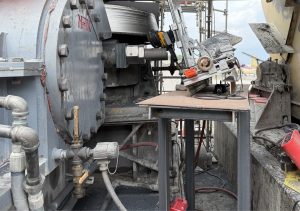
Over time, this cycle makes the unit increasingly difficult to control and can contribute to vibration, thrust problems, high power consumption, hot bearings, and accelerated wear of bases, piers, and drive components.
Many of these issues begin gradually and often go unnoticed until a major repair or component replacement becomes necessary. However, restoring worn surfaces before severe damage occurs can provide a cost-effective alternative to replacement and help extend the life of existing equipment.
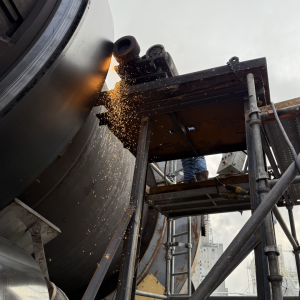
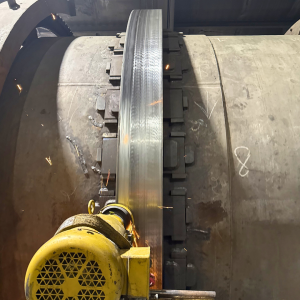
Grinding and resurfacing restore proper contact between tires and rollers, allowing components to operate more efficiently and reducing stress throughout the system. Irregular profiles, taper wear, pitting, circumferential grooving, timing marks, and rolled-over edges can all be corrected while the equipment remains in normal operation. Before and after measurements are recorded to ensure quality and precision, and only the minimum amount of material necessary is removed to restore true profiles and smooth contact surfaces.
Proper resurfacing provides several benefits, including:
-
Improved kiln stability and thrust control
-
Reduced vibration
-
Lower bearing temperatures
-
Lower energy consumption
-
Reduced tire retainer pressure
-
Extended bearing and component life
-
Reduced risk of premature failures
From a maintenance perspective, grinding and resurfacing represent a practical, budget-conscious form of preventative maintenance. Addressing wear before it leads to major mechanical issues allows plants to maximize the service life of their components while avoiding the cost and downtime associated with unnecessary replacements.
Another advantage is that all work is performed during normal production. Our grinding equipment allows tires, support rollers, and thrust rollers to be resurfaced in place without disrupting operations, providing plants with an opportunity to improve reliability without sacrificing production.
Unlike many service providers in the industry, NAK offers fixed pricing for grinding and resurfacing services. Plants can plan maintenance activities with confidence, knowing the scope and cost upfront without concerns over escalating charges.
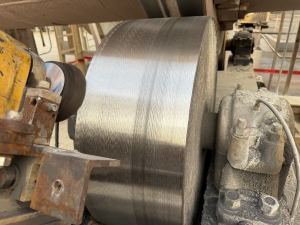
At NAK, grinding and resurfacing are about more than restoring surfaces. They are about improving mechanical stability, extending equipment life, reducing operating costs, and helping plants operate more reliably for the long term.
By taking a proactive approach to surface wear, plants can break the cycle of deterioration and turn what might become a costly repair into a manageable maintenance activity.
Ready to schedule? Give us a call at 1(800) 331-KILN or visit our website!